


This Mother’s Day feels different for me. Over the last few weeks, I’ve found myself thinking deeply about motherhood, lineage, and the ways we carry both love and pain through generations. About what motherhood actually means beneath all the noise that surrounds it. A dear friend recently shared the origins of Mother’s Day with me, and learning the history really clicked for me. The holiday was founded by a woman named Anna Jarvis in 1908 to honor her mother, Ann Jarvis, a peace activist and community organizer. It was created as a deeply personal day of reverence for mothers and the labor of care they carry. The day was meant to be intimate and reflective. And yet, years later, Anna Jarvis herself became deeply disillusioned by what Mother’s Day had become. Commercialized and consumed by industries built around consumption and profit. The performative gestures that slowly swallowed the deeper meaning whole.
When I learned that, I understood why lately, I’ve felt increasingly disconnected from many holidays. So many holidays have started to feel disconnected from their roots. So many sacred things become watered down over time. Traditions rooted in meaning become reshaped through capitalism, colonization, patriarchy, and systems that turn everything meaningful into something consumable, distorted and commercialized.
So this year, instead of focusing on flowers or curated images of motherhood, I found myself sitting in contemplation. Thinking about my own journey as a mother, and how motherhood has simultaneously been the most beautiful and most confronting experience of my life.
I thought about the last eight years of my life and how motherhood has transformed me in ways I could never have anticipated. Truthfully, I never imagined motherhood for myself. As a young girl, I didn’t dream about having babies one day. I actually felt uncomfortable around children for most of my life. The noise, the chaos, the crying, the messiness, the unpredictability of children simply being children. Children dysregulated me. At the time, I didn’t understand why my body reacted the way it did. I just thought something was wrong with me. Looking back now, I understand it differently.
As a childhood trauma survivor, my nervous system learned very early that loudness wasn’t safe, big emotions weren’t safe, unpredictability wasn’t safe. I learned very young how to shut down, dissociate, stay hyperaware, and survive. Those patterns followed me well into adulthood, and then eventually alcohol became another way to leave my body.
The Moment I Realized I Needed to Heal my Inner Child
By the time my husband and I decided to start a family after nearly a decade together, I was already in recovery. We eventually felt the deep desire to start a family together. We had placed images of family, pregnancy, and parenthood on our dream boards for years. We imagined a full, vibrant home filled with children. But no amount of dreaming prepared me for what motherhood would ask me to face. Pregnancy, birth, and postpartum transformed me physically and emotionally, but toddlerhood opened an entirely different doorway. Watching my children experience big emotions for the first time, activated something very tender inside me. I remember the terror I felt watching them cry over something seemingly small. Watching them scream, melt down, throw themselves onto the floor in frustration. My nervous system would immediately shift into fight, flight, or freeze. Sometimes my own reactions frightened me. I love my children with every fibre of my being, I would never hurt them like I was hurt. Their emotions were completely normal, but my body did not know that yet.
I remember sitting with the realization that my children were expressing things that had never been safe for me to express as a child. Loudness had consequences. Emotional expression often led to punishment, shame, fear, or unpredictability. My nervous system had been shaped by those experiences long before I had language for trauma. Becoming a mother forced me to recognize that healing could no longer remain conceptual for me. I could not continue surviving through disconnection, numbing, perfectionism, or dissociation while raising children who deserved emotional safety and presence. I needed to understand why my body felt unsafe in ordinary moments of childhood expression. I needed to meet the younger version of myself with tenderness instead of shame, something inside me knew I needed to get curious.
That journey led me deeper into trauma recovery than ever before. I explored somatic healing, deep nervous system work, inner child healing/shadow work, ancestral healing, earth based medicines and ceremony, meditation, recovery spaces, and practices that helped me reconnect to my body. I started learning how deeply my childhood had shaped my responses to conflict, emotion, noise, mess, and unpredictability. I also began grieving in ways I had never allowed myself to grieve before. Part of becoming a cycle-breaker meant allowing myself to acknowledge painful truths about my upbringing while still holding love for the people involved. That duality has been one of the most tender parts of healing for me. I love my mother deeply. I know she loves me deeply. I also carry wounds from my childhood that profoundly shaped me. Even writing those words still feels tender in my body. Both truths live side by side inside me. Many of us who come from enmeshed or dysfunctional family systems where love and harm coexisted, where dysfunction was normalized, where gaslighting taught us to question our own reality. We were taught to minimize harm, protect the image of the family, and remain silent in order to survive. This is the complexity many cycle-breakers carry. Healing requires us to reclaim our own truth without losing our humanity in the process.
The Cycles I Am Proud to Break
As I reflect on motherhood now, I feel immense pride in the cycles I am consciously ending inside my own home. My children have never heard me criticize my body or theirs. They have never been shamed for expressing emotions. My sons have never been told that “boys don’t cry” or taught that tenderness makes them weak. We talk openly in our home about feelings, accountability, conflict, repair, and responsibility. We apologize to one another. We name harm when it happens. We practice making things right after conflict. I watch my children now navigate conflict with each other in ways that move me deeply. Sometimes I overhear them validating one another, apologizing sincerely, hugging after disagreements, or taking deep breaths when they feel overwhelmed. Sometimes I walk into a room and see one of them practicing EFT tapping because they watched me do it enough times to normalize emotional regulation as care rather than shame.
I also see my own healing unfolding in ordinary moments that would have terrified earlier versions of me. I am learning to feel safe around mess. Around muddy clothes and scattered toys. Around noise and movement and children taking up space exactly as children should. I am learning to choose connection more often than perfection. As a mother navigating ADHD and CPTSD, this remains an ongoing practice for me. Some days still stretch my capacity. Some days my nervous system still feels overloaded. Healing has not made me perfect. It has made me more conscious, more compassionate, and more willing to repair.
One of the most healing parts of motherhood has been rediscovering play. Sometimes I tell my children that my inner child wants to come out and play with them. They always say yes with excitement and delight. So I dance with them. I color with them. I get messy. I laugh loudly. I allow myself softness and joy that once felt inaccessible. In those moments, I can feel something inside me slowly loosening and returning home to itself.
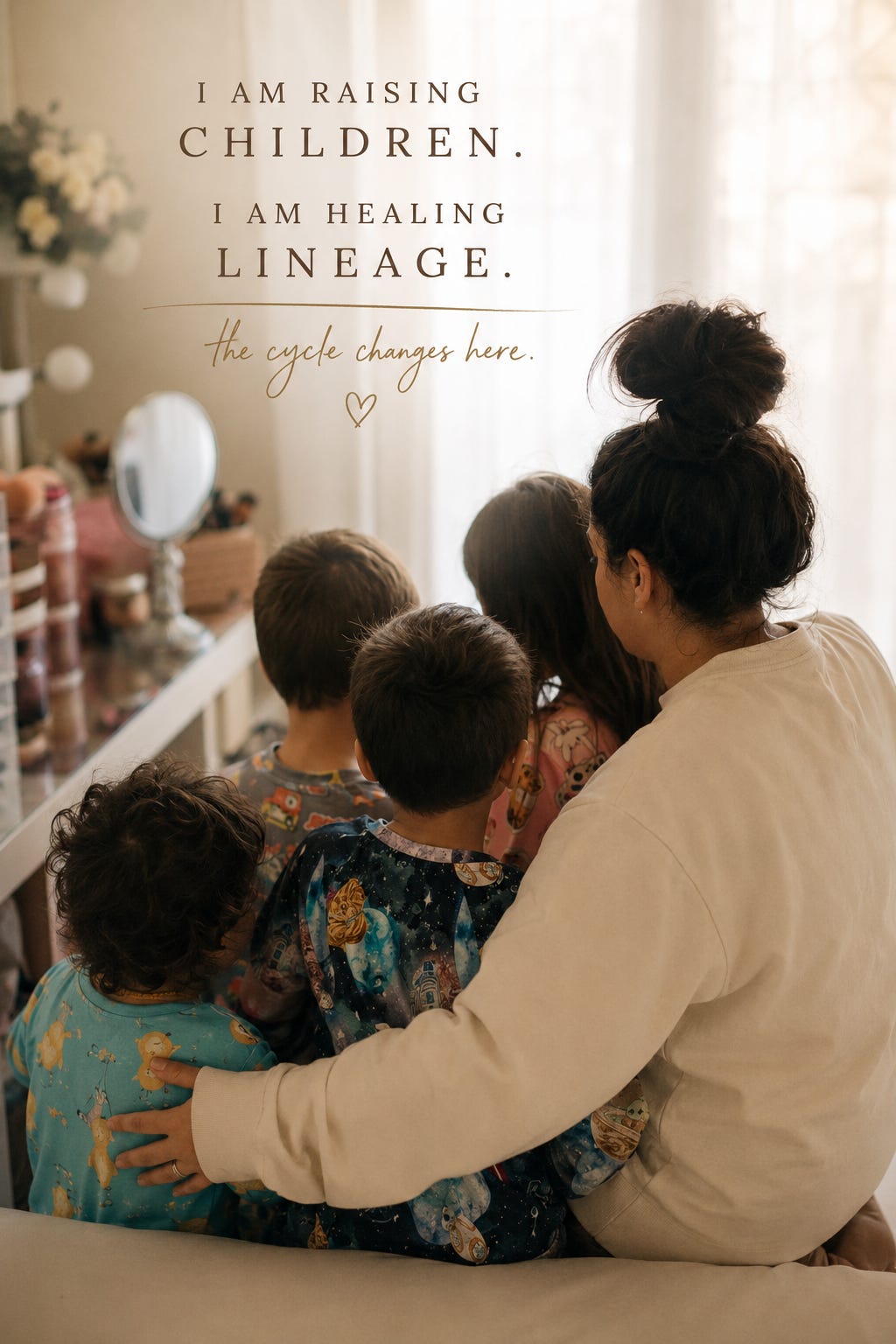
This Mother’s Day
This Mother’s Day, I am thinking about all the mothers who are parenting while simultaneously healing the parts of themselves that were wounded in childhood. I am thinking about the mothers who are grieving what they did not receive while intentionally creating something different for their own children. I am thinking about the women rebuilding emotional safety from the ground up without having a blueprint to follow. That work carries extraordinary courage. It lives in the small moments of everyday life. It lives in bedtime conversations, repair after conflict, honest apologies, deep breaths, patience, and presence. It lives in the decision to stay conscious when survival patterns would be easier.
I see us. I honor us. And I believe the sacredness of this work deserves to be remembered.
A Question to Sit With
What is one cycle you are consciously choosing to end…
through the way you love?
This is so powerful Abigail 🧡